Life Transitions Eating Disorder Recovery: 5 Powerful Strategies
life transitions eating disorder recovery

Life Transitions Eating Disorder Recovery: 5 Powerful Strategies

Life transitions in eating disorder recovery can be some of the most disorienting experiences — even when those changes are deeply wanted. Starting a dream job, moving to a new city, graduating, beginning a relationship, or settling into a new home can be joyful milestones. They can also stir up vulnerability, and for someone navigating life transitions in eating disorder recovery, old thoughts or behaviors may begin to reappear.

Consider “Michaela,” a composite of experiences I often hear in my practice. She had just moved into her first apartment in Los Angeles with close friends and begun the job she had hoped for since college. After completing a year-long eating disorder treatment program, she expected to feel only proud and excited.

Instead, she noticed familiar urges: skipping meals, rigid food rules, body checking, and the pull to use her eating disorder to manage discomfort. “Why now?” she wondered. “Everything is finally going well.”

The answer is not that Michaela has failed or that she does not deserve the good things happening in her life. It’s that positive change is still change — and that’s something that can be challenging to remind ourselves of.

Life Transitions Eating Disorder Recovery: 5 Powerful Strategies

Why Life Transitions in Eating Disorder Recovery Feel Hard

Our nervous systems often prefer what is familiar — not necessarily what is healthy. A new job, new city, new routines, new people, and new expectations can all require us to tolerate uncertainty. Even desired transitions can disrupt the structures that support recovery: regular meals, sleep, movement, therapy appointments, privacy, finances, and trusted relationships.

During those unsettled periods, the eating disorder may present itself as a familiar — sometimes harmful — way to create a temporary sense of control. Restriction, binge eating, purging, compulsive exercise, laxative misuse, diet-pill use, or emotional eating can become attempts to soothe anxiety, numb overwhelm, or manage perfectionistic pressure.

This does not mean a person has “lost” their recovery. Recovery is rarely linear. Research supports taking early shifts seriously without treating them as inevitable failure. In a longitudinal study of women in remission from bulimia nervosa and other eating disorders, negative stressful life events — including work and social stressors — were associated with a greater likelihood of relapse (Grilo et al., 2012).

The return of urges or early warning signs is information: Something feels unsteady, and I may need more support.

The awareness opens up the door to change.

Life Transitions Eating Disorder Recovery: 5 Powerful Strategies

The “Bambi Legs” of Life Transitions in Eating Disorder Recovery

At the FAB — Food and Body — Program, I sometimes describe this experience as having “Bambi legs.” Think of the young deer trying to find its footing: shaky, uncertain, and not yet steady on unfamiliar ground.

That is what life transitions in eating disorder recovery can feel like. You may be doing something deeply aligned with your values — taking a job, moving closer to community, returning to school, becoming a parent, leaving a relationship, or pursuing a long-held dream — while simultaneously feeling emotionally off balance.

While it would be ideal, the goal is not to eliminate all stress. That is neither possible nor necessary. The goal is to recognize that stress early and respond to it with recovery-supportive care rather than with the eating disorder.

Brené Brown has described the difficult in-between phase of change as “the messy middle”: the point after the familiar has ended but before the new feels secure. In recovery, the messy middle is not evidence that you are doing something wrong. It may be evidence that you are growing beyond an old way of coping.

Research from the National Eating Disorders Association (NEDA) underscores that stress and life change are among the most common triggers for symptom return — making awareness and early support especially critical during life transitions in eating disorder recovery.

Life Transitions Eating Disorder Recovery: 5 Powerful Strategies

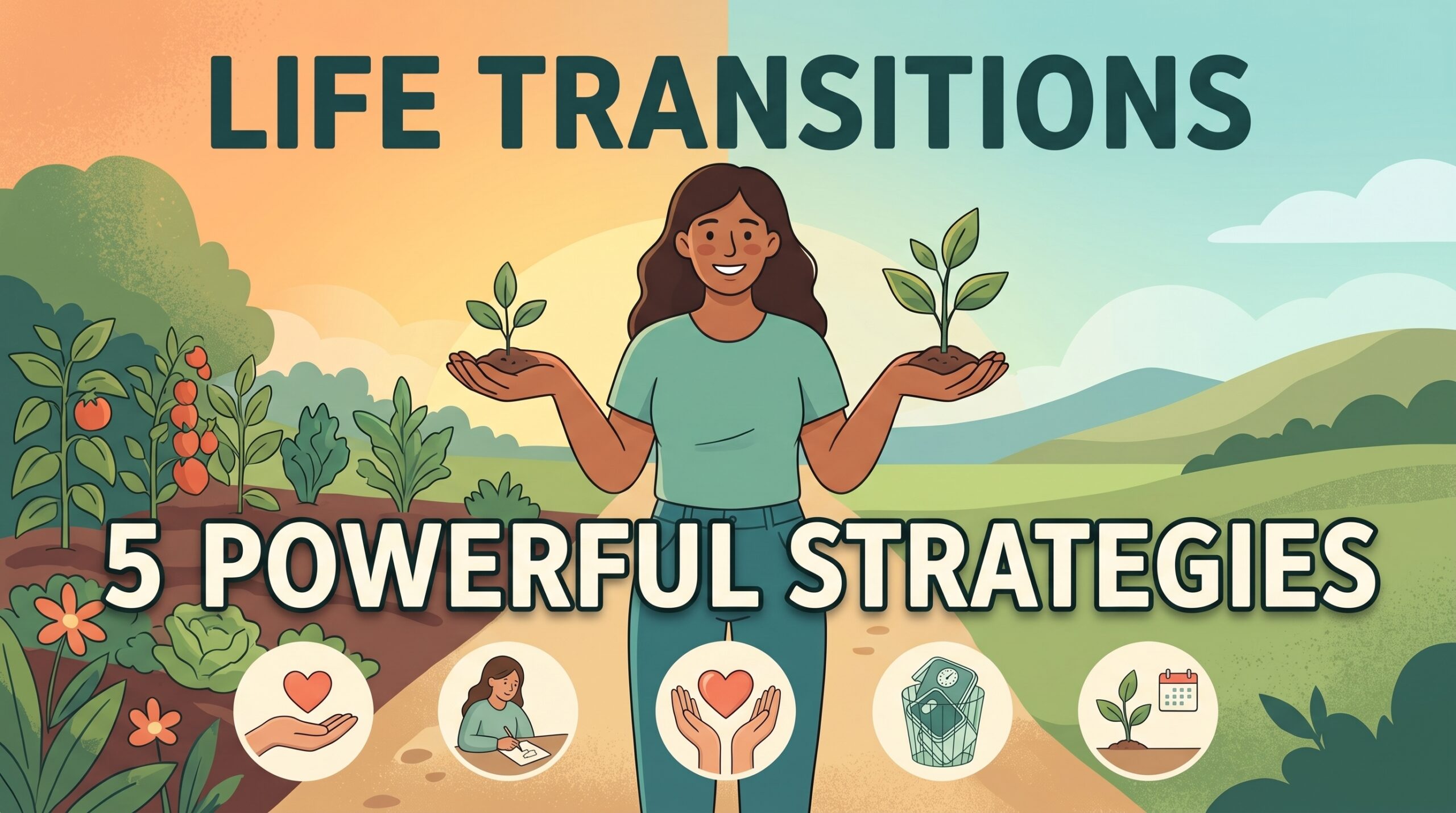
5 Powerful Strategies for Life Transitions in Eating Disorder Recovery

1. Make a Flexible Plan

Before or during a major transition, write down what will help you stay anchored. Include meal and snack structure, grocery and cooking plans, sleep, appointments, transportation, finances, movement boundaries, and emergency contacts. It’s empowering to take control of what you can control!

A plan is not meant to make life perfectly controllable. It is meant to reduce decision fatigue and create a compassionate structure when everything else feels new. Leave room for flexibility, because transitions rarely unfold exactly as expected.

For example, if you are moving for a new job, your plan might include identifying nearby grocery stores, arranging telehealth sessions before the move, scheduling regular check-ins with a dietitian, and asking a friend to eat with you during the first few weeks.

2. Identify Your Personal Warning Signs

Notice the small shifts that tend to come before a larger return to symptoms. For one person, it may be delaying breakfast. For another, it may be increased body checking, avoiding social meals, compulsive movement, scrolling diet-focused content, weighing, withdrawing from loved ones, or telling themselves that a behavior is “not that bad.”

The earlier you name a pattern, the more choices you have. Consider making a personal list of your emotional, behavioral, and social warning signs, along with the situations that tend to make you more vulnerable during life transitions in eating disorder recovery.

3. Do Not Transition Alone

Major life changes can be isolating even when they are exciting. Decide now who belongs on your support team: a partner, friend, family member, therapist, dietitian, physician, recovery coach, sponsor, or trusted colleague.

Be specific when you ask for help. Rather than saying, “I’m struggling,” try: “I am noticing urges to skip meals since the move. Can we have dinner together twice this week?” Or: “Starting this job has brought up more anxiety. Could you check in with me after my first few days?”

Support is not a sign of dependency or weakness. It is a recovery skill.

4. Increase Professional Support Temporarily

A transition may be an appropriate time to add sessions, not reduce them. Talk openly with your treatment team about the change ahead, your fears, your past patterns, and the behaviors you are most vulnerable to returning to.

Together, you can update a relapse-prevention plan, identify meaningful goals, review coping skills, and determine what would signal a need for a higher level of care. Research on post-treatment care suggests that aftercare may help prevent or slow relapse, though no single approach has been established as best for everyone. The most useful plan is usually individualized, sustained, and responsive to a person’s particular warning signs and needs (Giel et al., 2021; Pagano et al., 2023).

The Academy for Eating Disorders recommends proactively increasing clinical support during known periods of vulnerability — including life transitions in eating disorder recovery — rather than waiting for symptoms to escalate.

5. Use Your Coping Toolbox on Purpose

When anxiety rises, the eating disorder can feel automatic. That is why it helps to rehearse alternatives before you are overwhelmed.

Your coping toolbox may include:

  • Regular, adequate nourishment according to your recovery plan
  • Grounding or mindfulness practices
  • Journaling about what the transition is bringing up
  • Reaching out before an urge becomes an action
  • Restoring a sleep routine
  • Gentle, non-compulsive movement, if consistent with your treatment plan
  • Eating with supportive people
  • Cooking familiar meals or learning simple new ones
  • Limiting diet-culture and appearance-focused social media content
  • Naming the emotion beneath the urge: fear, loneliness, excitement, grief, pressure, or uncertainty

The question is not, “How do I make this feeling disappear?” Instead, ask: “What am I actually needing right now — and what recovery-supportive action can help meet that need?” The answer to this question can make all the difference!

Life Transitions Eating Disorder Recovery: 5 Powerful Strategies

Let Growth Count

A major transition may feel chaotic, stressful, and emotional. It can also be a “good problem”: evidence that you have built a life with possibilities, relationships, opportunities, and movement.

When Michaela recognized that her symptoms were a signal rather than a personal failure, she was able to respond differently. She reconnected with her dietitian, arranged more frequent therapy sessions, made a plan for meals around her new work schedule, and told her roommates what support would be helpful. The urges did not vanish overnight, but she did not have to face them alone — or obey them.

Try a brief daily acknowledgment practice:

“Today, I am adjusting to something new. It makes sense that I feel unsteady. I can feel uncomfortable and still choose recovery.”

Change will remain part of life. The task is not to avoid it or to wait until you feel perfectly confident. It is to move through it with support, structure, flexibility, and self-compassion — so that recovery remains your anchor while the rest of your life expands.

If eating disorder symptoms are returning or escalating, contact your treatment team or a qualified eating disorder provider promptly. Early support can help interrupt a lapse before it becomes more entrenched.

Life Transitions Eating Disorder Recovery: 5 Powerful Strategies

Stay Connected with FAB

If this was helpful in any way, we’d love for you to stay connected with FAB. Here are a few resources to explore next:

Experiencing or Witnessing Signs of an Eating Disorder?

  • Take the Self-Discovery Quiz — A quick way to reflect on your relationship with food and body, and see if FAB might be the right fit for you. Take the quiz

  • Download the Body Image Ebook — A free resource to help you better understand and navigate body image struggles. Get the ebook

  • Schedule a Consultation — Ready to talk? Book a free call with our team to explore what support could look like for you. Schedule here

For Professionals

  • Get the Clinical Quick Guide — A practical resource for professionals looking to better understand and support clients with eating disorders. Download the guide

  • Meet with Dr. Jen — Interested in a referral partnership? Find time on her calendar to connect. Schedule a meeting

Selected References

Grilo, C. M., Pagano, M. E., Skodol, A. E., Sanislow, C. A., Bender, D. S., Gunderson, J. G., Stout, R. L., Shea, M. T., Yen, S., & McGlashan, T. H. (2012). Stressful life events predict eating disorder relapse following remission: Six-year prospective outcomes. International Journal of Eating Disorders, 45(2), 185–192.

Giel, K. E., Schmidt, U., & Zipfel, S. (2021). Efficacy of post-inpatient aftercare treatments for anorexia nervosa: A systematic review of randomized controlled trials. Journal of Eating Disorders, 9, 128.

Khalsa, S. S., Portnoff, L. C., McCurdy-McKinnon, D., & Feusner, J. D. (2017). What happens after treatment? A systematic review of relapse, remission, and recovery in anorexia nervosa. Journal of Eating Disorders, 5, 20.

Pagano, N., et al. (2023). Perspectives on relapse prevention following intensive treatment for eating disorders: A qualitative study. Journal of Eating Disorders.

Author

Back to Blog

©FAB Food & Body Program

Terms and Conditions