I had a parent in my office recently, worried about her young teen after the school nurse reached out to her about her daughter‘s health. Sarah seemed like a happy kid with a funny sense of humor and she liked playing the violin. Recently her grades were beginning to slip in a few of her classes. She had always been such a good student and mother was worried about this. She was also going through puberty and mom also said she was uncomfortable with her changing body.
One of Sarah’s friends, Jackie, had told the school nurse that she was worried about her friend because she never ate around her. What prompted Sarah’s friend to go to the nurse was she heard Sarah in the bathroom stall throwing up. Jackie said that she tried to sit with other friends at lunch because it made her uncomfortable to see Sarah not eating and she wasn’t as fun to be around anymore.
The school nurse was suspecting that Sarah may have an eating disorder. Mom was very surprised that her child who lives under their roof, was reportedly eating very little food for hours on end per the report by the nurse. The nurse also stated to Mom that she was falling asleep in some of her classes and was missing some of her assignments, which was not typical of her.
Mom told me and the nurse that she gave Sarah lunch money to have breakfast and lunch at school. She assumed that she was eating with her classmates.
Mom m saw her eat when she came home from school. She would prepare large amounts of snacks, and appeared to enjoy eating her food. Mom said that they sometimes didn’t eat as a family but always made sure Sarah had something for dinner. She had recently seen her pediatrician and her child was not under weight.
By the time I met with Sarah, she had shared that she had been dieting for the last two years. She reported more restrictive eating recently and was weighing herself every day. She also reported that there were a few occasions where she made herself throw – up when she felt like she ate too much.
She said she rarely ate an actual breakfast besides having orange juice. Once a week she’d allow herself to have pasta during lunch, but mostly, she would only fruit rather than an actual meal. She shared that her friends never commented on her lack of eating. She didn’t know Jackie had gone to the school nurse. She really didn’t think what she was doing was “ that big of a deal”.
She said if she could just lose a few more pounds, she would try to go back to regular eating. She said her period had stopped over the last six months, but she wasn’t sure why.As you are seeing with the story of Sarah, she is mostly struggling alone. Her parents are in the dark that she is struggling with a potentially serious eating disorder. She is not even admitting to herself that there is a problem. She is minimizing the severity of any of her behaviors.
Her relationship with food and her body is now appearing to impact her physical health, given that her period has now stopped. She’s also falling asleep in class which suggest low energy potentially from her poor nutrition which seems to be affecting her grades. Her relationships are beginning to be affected as well. Jackie felt worried enough to go to the nurse and is no longer wanting to share time together during lunch time.
This story of Sarah a very common one that I have heard over the last decades of working with those struggling with food and body issues.
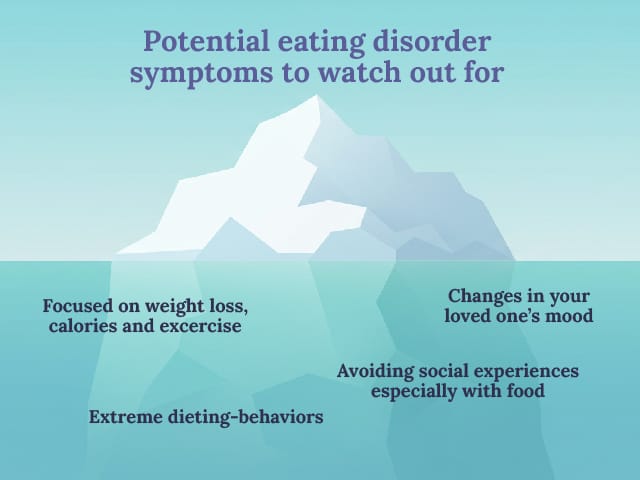
Each person’s eating disorder symptoms may appear differently which can also contribute to making it more difficult to determine whether your loved one is having issues with disordered eating and to the extent that they may be struggling.