Joyful Movement in Eating Disorder Recovery
Joyful Movement in Eating Disorder

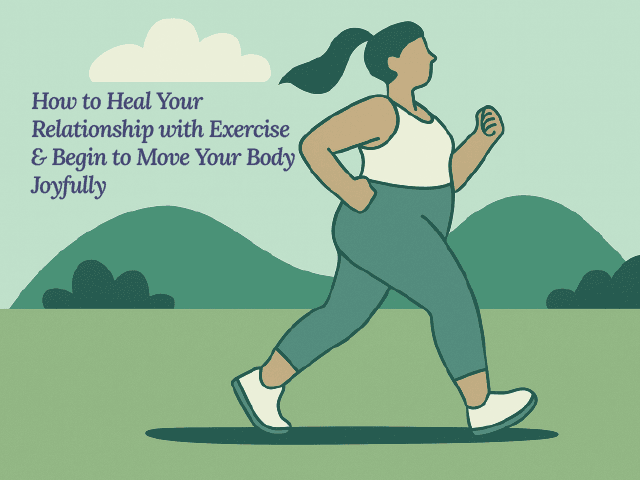
How to Heal Your Relationship with Exercise & Begin to Move Your Body Joyfully

In our society, exercise is often associated with losing weight, burning calories, and getting your “bikini body” ready for summer. The term ‘working out’ is currently one of the most common terms for exercise. I find it necessary to point out that in the term ‘working out,’ you can find the word ‘work.’ This, in and of itself, shows how exercise has transformed into something that we feel like we have to do, instead of something we want to do.

For some of us that struggle with food and body issues, exercise and ‘working out’ have become very much connected to our eating disorder behaviors. We get so obsessed with the idea of burning calories and losing weight that we begin exercising to an excessive level so that we can burn MORE calories and lose MORE weight. We might even become compulsive exercisers. And that is an eating disorder behavior itself — excessive exercise is actually a form of purging. Recovering from this often involves therapy and the help of a specialist to help you let go of the rigidity around exercise and discover new, healthier ways to move your body.

For some of you, physical activity and movement might not bring about the most joyful memories, as you might not have had the greatest experiences with it in your past. Even the thought of movement might have you feeling kind of “ugh.” If this applies to you (or if this has applied to you in the past), let’s take a moment to explore this a little more deeply…

There are often reasons that we develop a level of “resistance” to physical activity and movement. Some contributors may include:
  • Being forced to exercise as a child.
  • Being shamed for your physical abilities.
  • Seeing physical activity as a punishment for being in a larger body.
  • Unrealistic rules regarding the type and amount of physical activity that had to be done.
  • Past injuries or fear of being injured.
  • Negativity around your body image, resulting in hiding and/or not moving your body.
Here is the good news–just because this is the way it has gone, does not mean that it has to keep going this way. Your relationship with physical activity and movement can change into something positive and joyful. This is called joyful movement. 
 
Eating disorder recovery requires you to live in the discovery. Let’s try to discover and create a new way of moving our bodies!
 

Reflecting on Your Movement Intentions

Think about the last time you moved your body…
 
  • What form of movement was it?
  • Can you recall your intention behind moving your body in that way?
  • Did you want to feel joyful and have fun? 
  • Did you need to release some stress or excess energy? 
  • Did you just want to get out and spend some time in nature?
  • Or did you have to exercise because you ate too much yesterday?
  • Maybe you looked in the mirror this morning and your clothes felt a little tighter.
 
Joyful Movement in Eating Disorder

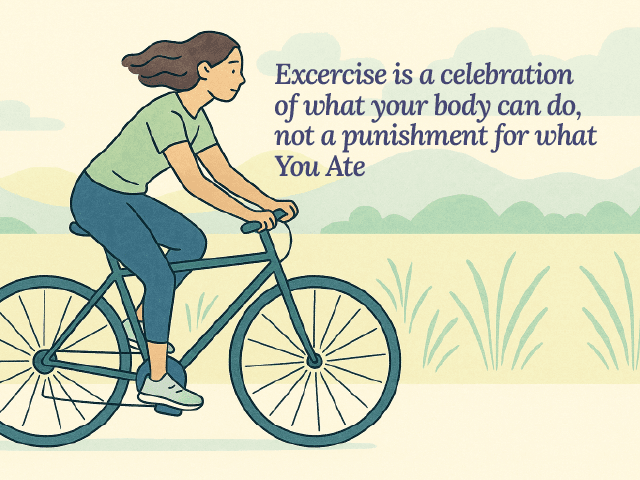
In eating disorder recovery, we want to move from the concept of ‘Exercise as Punishment,’ to the concept of ‘Movement through Joy.’ Therapy services can support you in this transition, guiding you toward healthier intentions and strategies.

So what does movement through joy look like? Well, joyful movement is an approach to physical activity that emphasizes finding pleasure and joy in the way we move our bodies. This is often a foreign concept to those of us with eating disorders. We often force ourselves to exercise as a form of compensation or punishment. And we often partake in types of movement that we dislike, because we want results, and we want them fast. (This is toxic, ED-driven movement!)

So, how do we distinguish between healthy movement and toxic movement?

We look at our INTENTIONS!

  • Here are some examples of Healthy, Joyful Movement intentions…
  • I want to move my body because….
  • I need some stress relief!
  • My body is craving movement, and I want to honor my body.
  • I want to ‘sweat it out’ in nature.
  • I need to let out some built up energy.
  • I GET to–my body GETS to move today.
  • I want to keep up with my kids!
  • I want to feel strong in my body.
  • I want to celebrate what my body can do!

Now, here are some examples of Toxic, ED-Driven Movement intentions…

  • I want to move my body because….
  • I ate too much food today.
  • I haven’t worked out all week.
  • I hate my body.
  • I need to earn my dessert tonight.
  • My reflection in the mirror disgusted me.
  • My clothes are too tight.
  • I need to lose weight.
  • I need to change my body.
Joyful Movement in Eating Disorder 3

This is where joyful movement differs–the intention behind joyful movement is to have fun, to find pleasure, and to find joy through movement.

Some examples of joyful movement are…

  • Walking
  • Hiking
  • Roller Blading
  • Swimming
  • Gardening
  • Dancing
  • Weight-Lifting
  • Ice Skating
  • Sports
  • Yoga
  • Running
  • Bicycling
  • Walking the Dog
  • Kayaking
  • Jumping on the Trampoline!
It’s important to recognize that for some people, typical “toxic ED exercises” (like running or weight-lifting) might truly be a form of joyful movement for them. This is a delicate area, which is why it is SO important to check your true intentions behind the exercise. Therapy and specifically the help of a specialist can help you clarify your intentions and guide you toward movement that truly helps to support you in your recovery. 
 
As you engage in movement throughout your recovery, keep your intentions in mind. Remember, we want to challenge what your eating disorder is telling you to do–if your ED gremlins are screaming at you when you move your body joyfully, you’re doing it right!
 
So, to reiterate, the goal is to move your body because you want to and you get to–not because you have to.
 
 
Reconnecting with Joyful Movement
An easy way to ensure you are moving your body because you want to and because you get to is to think about how you used to move your body when you were a kid.
 
 
Think about it! Maybe you used to hopscotch, jump in puddles, dance, jump on the trampoline. The way we moved our bodies as children represents the simplicity of joyful movement.
 
We did not move to change our bodies.
We did not move to look a certain way.
We moved to release energy and to have fun.
 
 
What you must remember is that any form of movement can turn TOXIC if your intentions change. And YOU are the only one who will ever truly know your intentions behind movement.  So, after reading about all the kinds of joyful movement, we want to know…
What forms of movement do you genuinely enjoy?

Take the Next Step: Get Help from a Team
FAB’s Body Image Therapist, Morgan, can help you heal your relationship with movement. If you are thinking of seeking treatment and trying therapy or are wanting to take the next step in healing your relationship with movement, take the FAB quiz. This two minute quiz on our website will provide insight into your relationship with food, body, and exercise. From there, you can choose to set-up a consultation with a FAB specialist to explore further the ways you may be struggling

Author

Back to Blog

©FAB Food & Body Program

Terms and Conditions